October 31, 2008
Bitcoin: A Peer-to-Peer Electronic Cash System
Publishing of 'The Bitcoin Whitepaper' officially established the fundamental engineering blueprint of the Bitcoin Network: a global monetary network with a fixed-supply digital bearer asset ⸺ without a central authority.
Post-launch Quote
“As a thought experiment, imagine there was a base metal as scarce as gold but with the following properties: boring grey in colour, not a good conductor of electricity,not particularly strong, but not ductile or easily malleable either, not useful for any practical or ornamental purpose, and one special, magical property: can be transported over a communications channel. If it somehow acquired any value at all for whatever reason, then anyone wanting to transfer wealth over a long distance could buy some, transmit it, and have the recipient sell it. Maybe it could get an initial value circularly as you've suggested, by people foreseeing its potential usefulness for exchange. (I would definitely want some) Maybe collectors, any random reason could spark it. I think the traditional qualifications for money were written with the assumption that there are so many competing objects in the world that are scarce, an object with the automatic bootstrap of intrinsic value will surely win out over those without intrinsic value. But if there were nothing in the world with intrinsic value that could be used as money, only scarce but no intrinsic value, I think people would still take up something.”
The Infamous Quote
“Banks must be trusted to hold our money and transfer it electronically, but they lend it out in waves of credit bubbles with barely a fraction in reserve. We have to trust them with our privacy, trust them not to let identity thieves drain our accounts. Their massive overhead costs make micropayments impossible.”
The Intro Story:
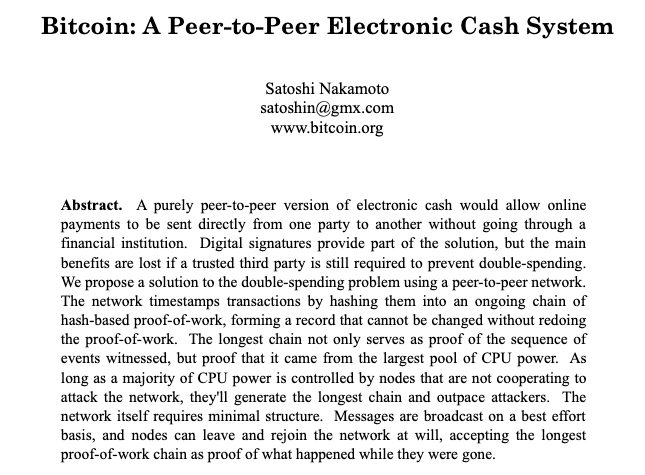
On October 31, 2008, a pseudonymous author using the name 'Satoshi Nakamoto' posted a nine-page document to the Metzdowd Cryptography mailing list. The list was a long-running venue for researchers working on digital cash, privacy, and distributed systems. The academic paper proposed a system titled "Bitcoin: Peer-to-peer Electronic Cash System" a global monetary system that did not require a trusted third party. It arrived after nearly four decades of work on digital money and related tech across academic and private research groups. Earlier proposals such as David Chaum’s eCash, Adam Back’s Hashcash, Wei Dai’s b-money, Nick Szabo’s bit gold, and Hal Finney’s 'reusable proofs of work' had each solved pieces of the problem. None had produced a working system that remained operational without a central operator. The Official Bitcoin Whitepaper combined those prior results into a single elegent, and bullet-proof design.
Photo: Bitcoin Whitepaper Intro Paragraph
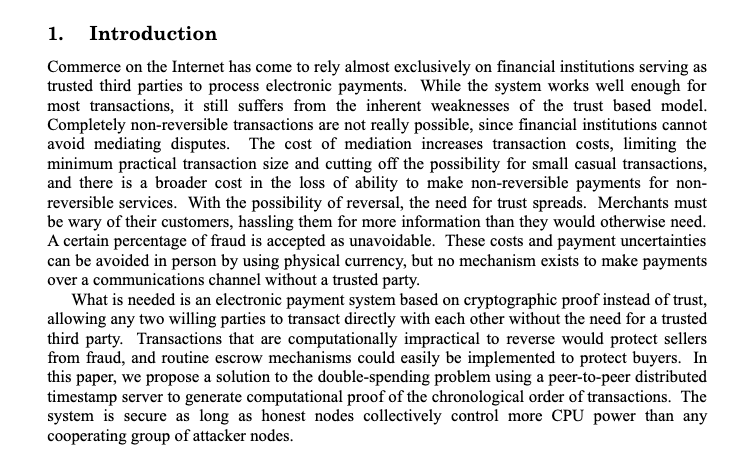
The construction draws on several distinct technical lineages. Game Theory supplies the incentive structure that aligns participants. Software and Distributed Computing provide the means to run the same rules across independent machines. Public-key Cryptography and the Elliptic-Curve Digital Signature Algorithm (ECDSA) allow ownership to be proven without revealing Private Keys. Proof-of-Work, adapted from Hashcash, requires computational effort to append blocks and makes history expensive to rewrite. Application-Specific Integrated Circuits (Asic's) later increased the cost of that work, but the original design did not depend on any particular hardware. The engineering-phenomenon within the 'Difficulty Adjustment', automatically keeps block intervals near ten minutes as total computational power changes. Together these elements produce "Unforgeable Costliness" -the ledger, known as the 'Bitcoin Blockchain' cannot be altered without expending real resources, (billions of dollars) and the official monetary supply distribution schedule cannot be expanded by any single party. The result solves more than the decades-old 'unsolvable' Byzantine Generals problem of coordinating unreliable nodes. It also constrains the supply of the unit itself.
Image: Monetary Supply Equation
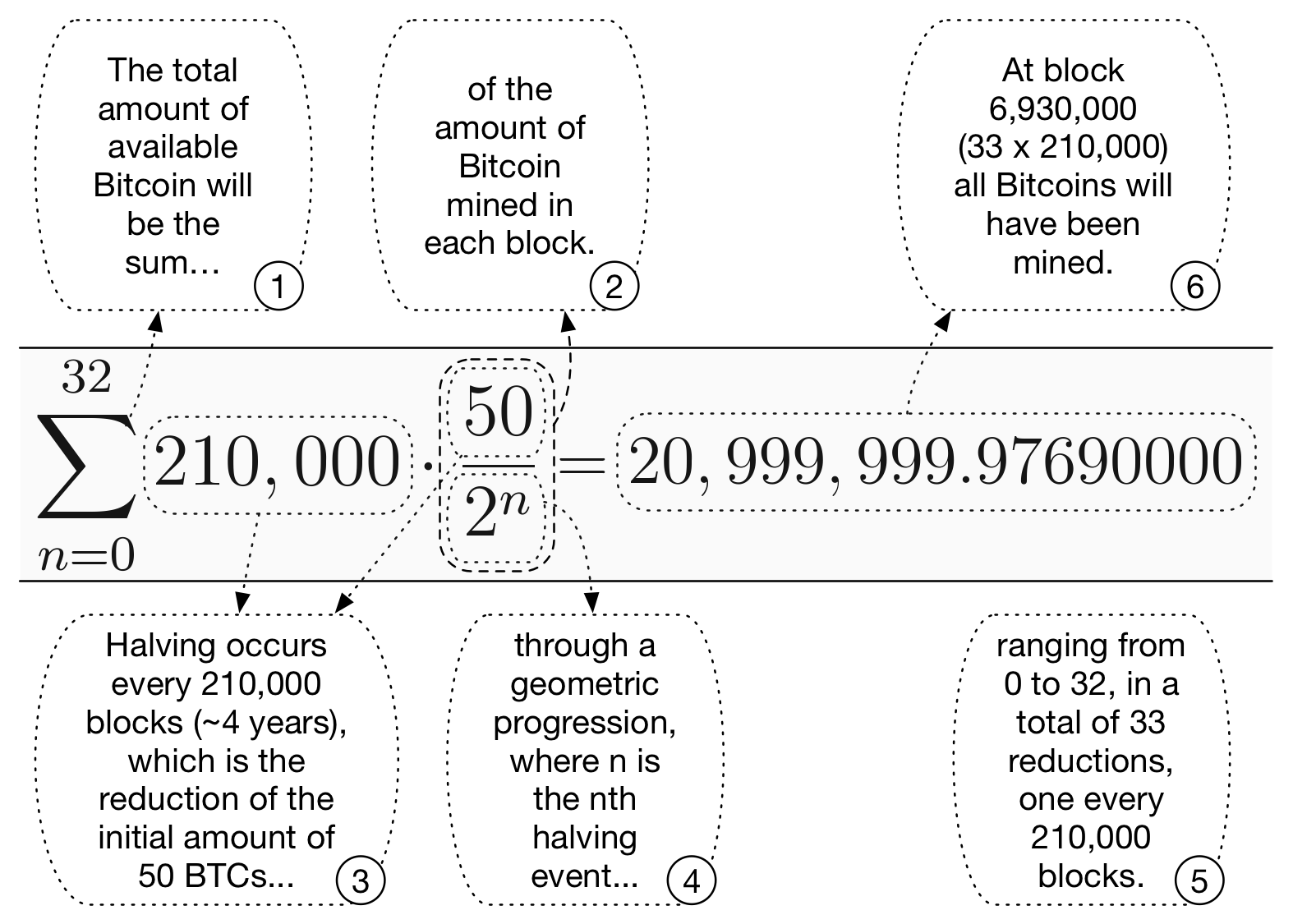
The fixed supply is enforced by participants who run the reference implementation and reject blocks that violate the rules. No issuer can increase the limit. No court order can compel a node operator in another jurisdiction to accept a modified chain. This produces a definitive separation between 'monetary policy' and 'political authority' that all earlier digital cash systems could not achieve.
Photo: Bitcoin Issuance Schedule Equation
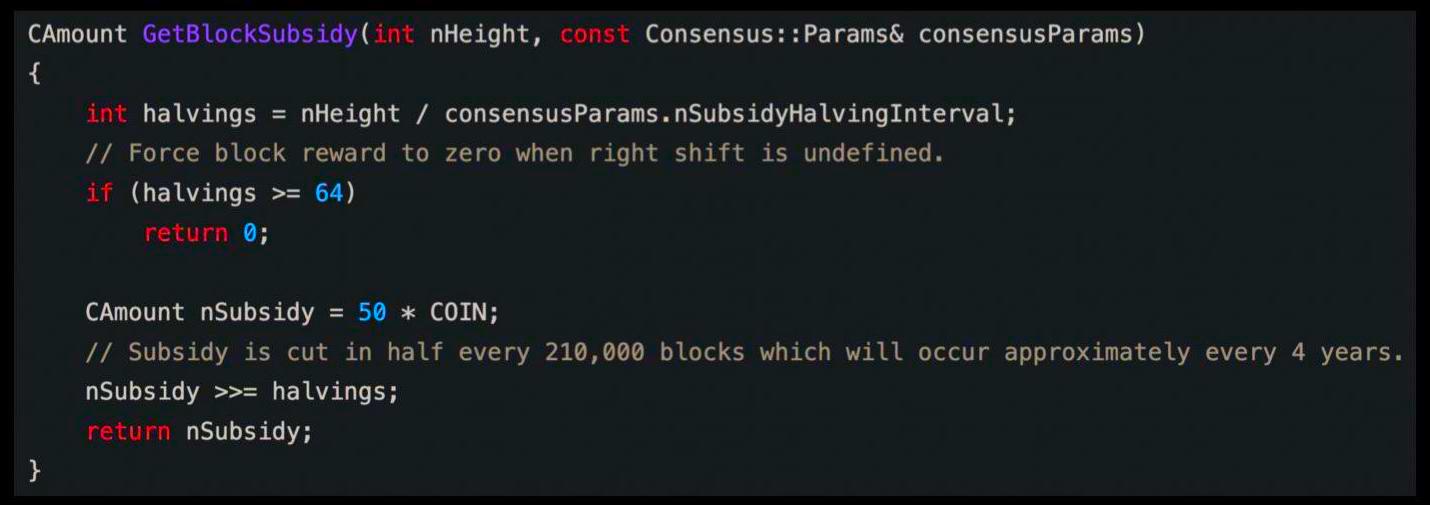
There is no correct or incorrect way to use the resulting network-native, digtal bearer asset. Many bitcoin holders treat it as a long-term store of value. Others use it for retail and bill payments, or family and friend remittances. Two rapidly growing use cases of bitcoin are as a 'non-correlated hard money asset' for publicly-traded corporations, as a treasury reserve asset. The other, as 'Pristine Collateral', highlighting it's growing status as decentralized digital sound money. The Bitcoin Network records valid transfers according to the rules and does not evaluate the purpose of those transfers or use cases. The whitepaper remains the reference document for the original design. Subsequent implementations have refined performance and security, but the core constraints—fixed supply, proof-of-work consensus, and open participation—have not changed.
Photo: Terminal Bitcoin Monetary Policy
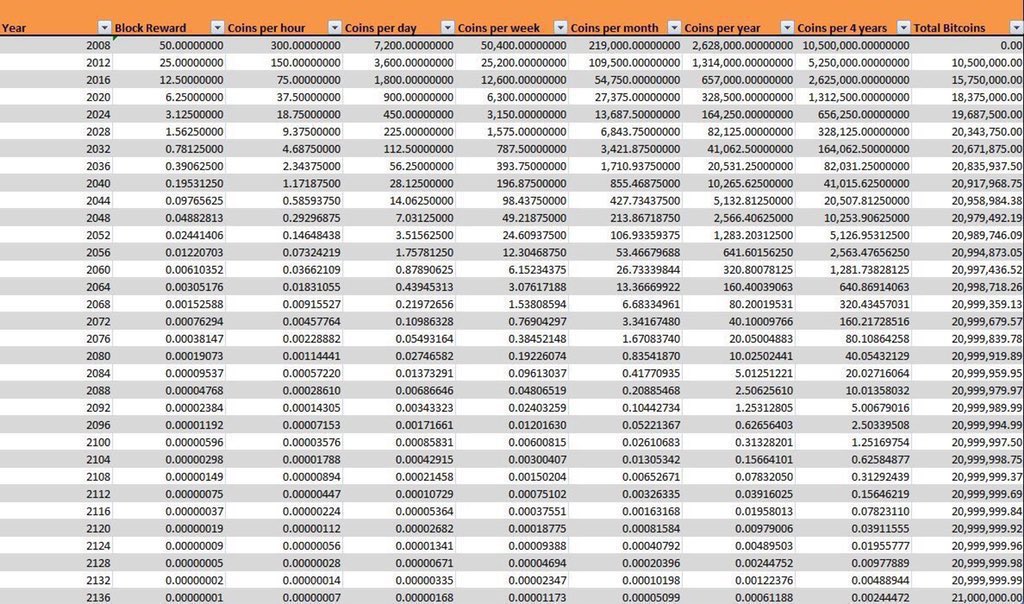
The design addresses a longer problem than coordination among nodes. Commodity monies and state-issued currencies have repeatedly failed as stores of value when the cost of producing new units fell or when the issuer expanded supply. Silver and gold coinage was debased by reducing fineness. Paper claims on metal were suspended or defaulted. Fiat units, once detached from any external constraint, expanded according to political and fiscal requirements. In each case the unit continued to function as a medium of exchange and unit of account while its purchasing power declined. The whitepaper’s fixed supply schedule removes the ability of any single party to alter the total number of units after the fact. Every four years, approximately 210,000 blocks, the engineered network subsidy, a hard-coded 'monetary policy' in the protocol rules of the Bitcoin Software, per the miner coin base reward schedule, automatically cuts the supply of new coins in half. Mathematics in motion: Absolute digital scarcity. Delivery? Decentralized digital sound money.
Photo: Bitcoin Network Havling Schedule
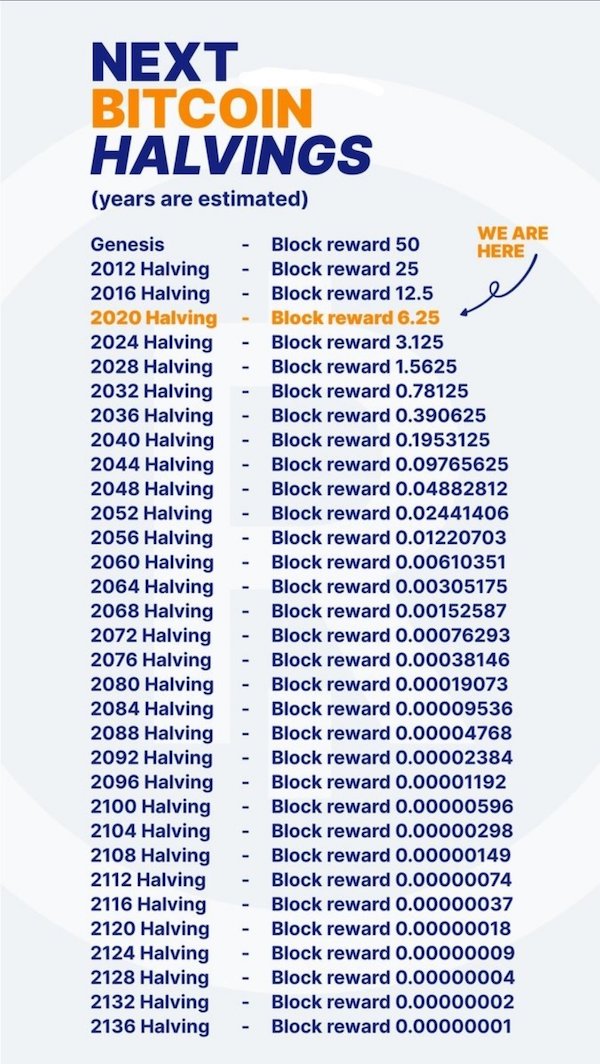
The schedule is enforced by the same nodes that order transactions. A block that would create units beyond the defined limit is rejected. No participant can unilaterally increase the schedule, and no external authority can compel the network to accept a larger limit. Holders who prefer a different rule can only exit or attempt a fork that the majority rejects. The constraint is therefore not a promise by an issuer; it is a property of the rules that participants choose to run. This does not eliminate price volatility or guarantee adoption. It does eliminate the mechanism by which prior monies were expanded after issuance.
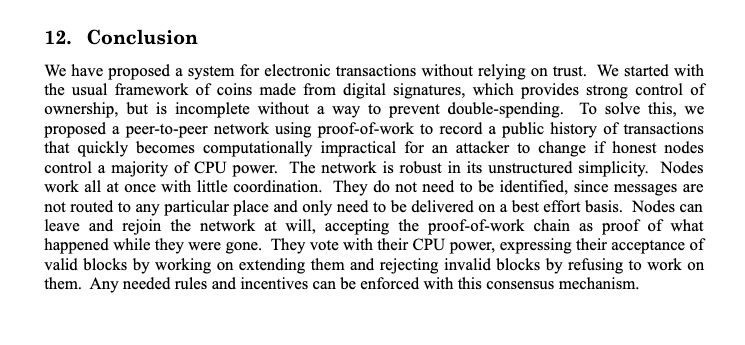
Photo: Bitcoin Whitepaper conclusion paragraph
Bitcoin Network: The Genesis Block
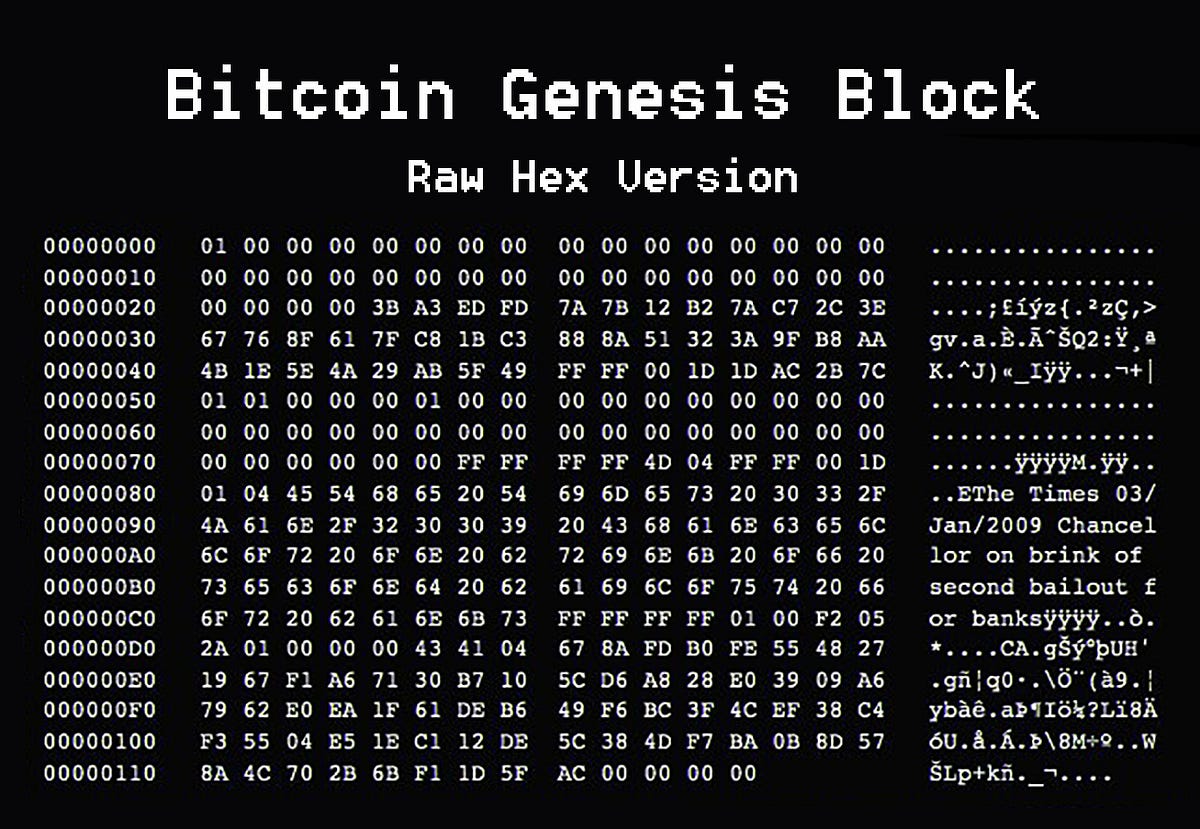
On January 3, 2009 the Bitcoin Network was launched as the peer-to-peer network established its first node connection. Embedded into the first block of the Bitcoin Blockchain was a message.
The Genesis Block Quote
"Chancellor on brink of second bailout for banks"
Photo: Bitcoin Network Genesis Block
The protocol is a breakthrough in computer science that produced a working system for decentralized digital sound money. Much of the world is still encountering the Bitcoin Network for the first time. The design has multi-century potential as a public good and apolitical monetary infrastructure -a universal monetary ledger of truth. In recent years members of the U.S. Federal Government and U.S. Military have stated on the record the Bitcoin Network carries implications for national security and is being studied.
Share our link with friends and family.