Core System
Bitcoin Blockchain
The Bitcoin blockchain is a global, transparent, append-only universal ledger of truth. It is the shared record of every bitcoin transaction and the current state of ownership. It functions as a form of triple-entry accounting: the sender, the receiver, and the network itself all record the same event. Once a transaction is included in a block and confirmed by the network, it becomes part of a permanent, publicly verifiable history.
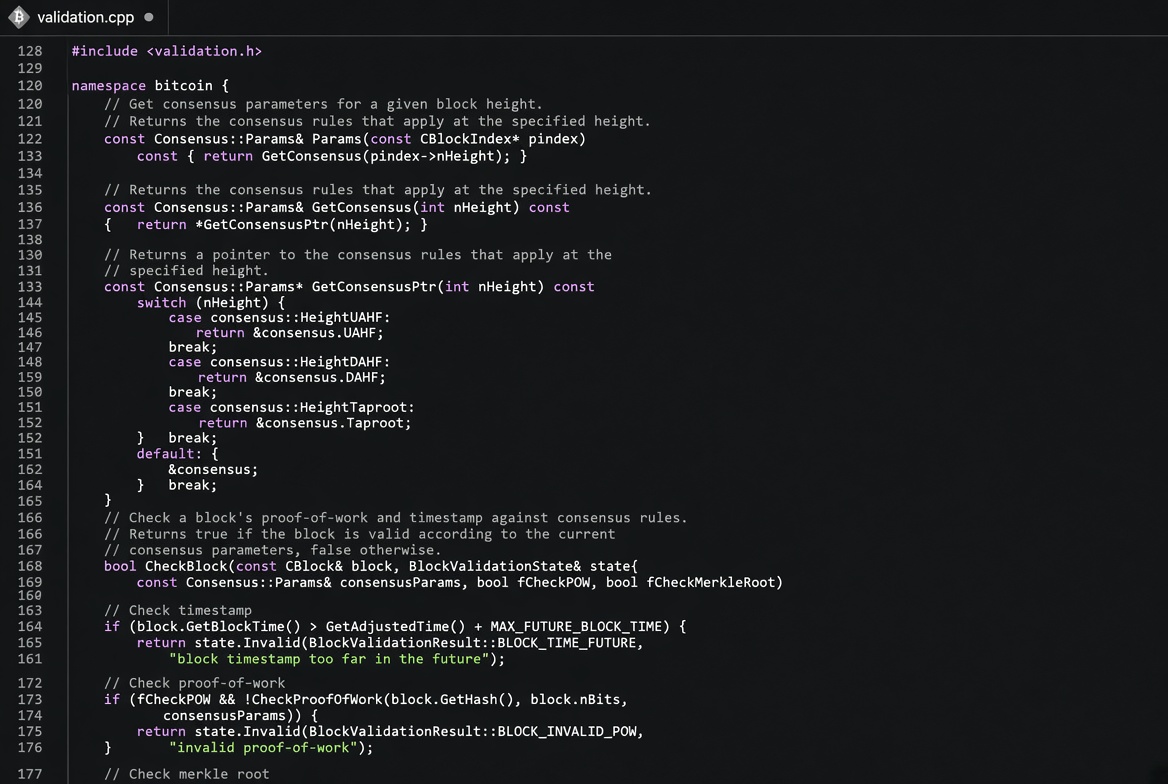
A block is a batch of valid transactions plus a header that links it to the previous block. The link is a cryptographic hash. Changing any earlier transaction would change the hash of that block, which would break every subsequent block. Nodes enforce this rule. They reject any chain that does not satisfy the consensus rules. The result is a single, ordered history that is extremely difficult to rewrite after the fact.
New blocks are produced roughly every ten minutes. Miners compete to find a valid block that meets the current difficulty target. When one is found, it is broadcast across the network. Every node independently verifies the block and the transactions inside it. Valid blocks are added to each node’s local copy of the chain. The chain with the most accumulated proof-of-work is treated as the authoritative history.
Key Properties
- Append-only. Data can be added but not silently removed or altered.
- Transparent. Anyone can download and verify the full history.
- Chronological. Blocks are ordered by height and linked by hash.
- Consensus-enforced. Nodes reject invalid blocks and transactions.
- Probabilistically final. Each additional block makes prior transactions harder to reverse.
- Permissionless to read. No identity or approval is required to verify the ledger.
How Transactions Are Recorded
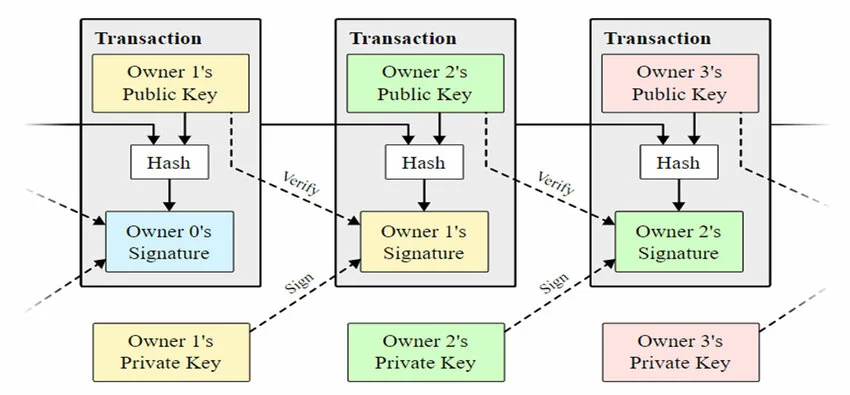
A transaction spends one or more unspent transaction outputs (UTXOs) and creates new ones. The owner of an output must provide a valid cryptographic signature to spend it. Nodes check that the inputs exist, have not already been spent, and that the signature is valid. Only after these checks pass is the transaction eligible for inclusion in a block.
Once a transaction is included in a block, it is considered confirmed. Additional blocks built on top of that block increase the cost of reversing it. Six confirmations is a common convention for large transfers, though the actual security depends on the amount of proof-of-work accumulated after the transaction.
Independence and Verification
Every full node maintains its own copy of the blockchain and validates every block and transaction against the consensus rules. There is no central authority that nodes must trust. The ledger’s integrity comes from the combination of cryptographic linking, proof-of-work, and widespread independent verification. Anyone can run a node and arrive at the same view of history without relying on a third party.
The blockchain does not store balances directly. It stores a history of transactions. Wallets and explorers calculate balances by scanning the chain for unspent outputs. This design keeps the system simple at the base layer while still allowing anyone to determine ownership of every bitcoin.
Up Next: Bitcoin Miners
Bitcoin Miners →Go back to Education Portal:
← Learn About Bitcoin℠Share the link with colleagues, family, and friends.
Fresh start? Official Bitcoin Network homepage.
By accessing this website you agree to the User Agreement, Privacy Policy, and Legal Notice.