Core System
Bitcoin Network
The Bitcoin Network is a peer-to-peer monetary system that settles value without a central operator. It has no headquarters and no single point of failure. Participants run software that follows a shared set of rules. When those rules are followed, transactions can be broadcast, verified, and recorded on a public ledger. The network is the system. Its native unit, commonly called bitcoin, BTC, or XBT, is the fixed-supply bearer asset used to transfer and measure value on that system.

The Bitcoin Network is not a single technology. It is a decades-long integration of several independent advances: public-key cryptography, peer-to-peer networking, proof-of-work consensus, and a transparent, append-only ledger. These elements operate together so that value can move between participants who do not need to trust one another or a central intermediary. The result is a global settlement layer whose rules are enforced by the nodes that choose to participate.
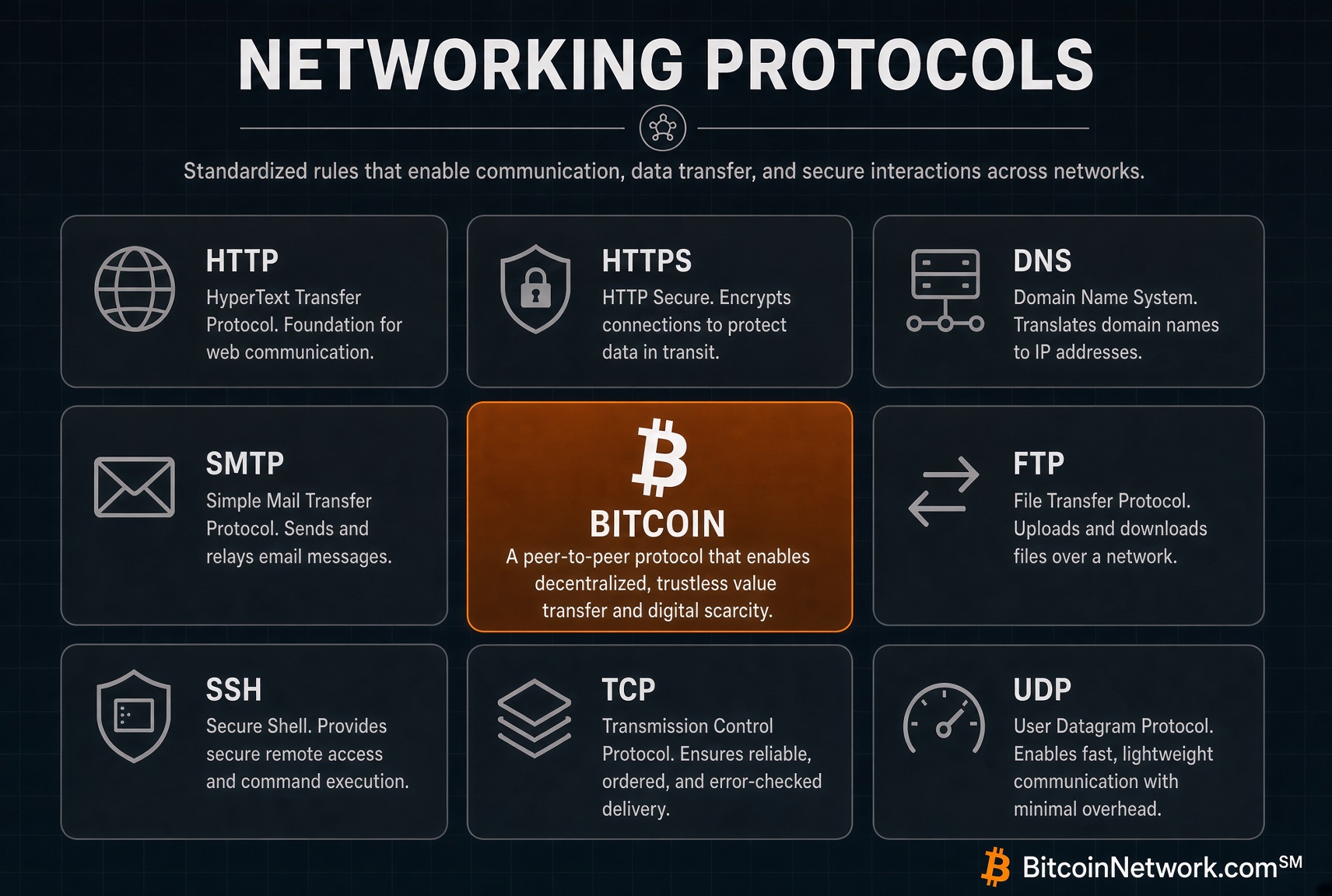
Like other network protocols people already use every day—DNS for domain names, HTTPS for web traffic, SMTP for email, or SMS for text messages—the Bitcoin Network is a set of rules that software follows. Most users never see the protocol itself. They only see the applications that implement it. The Bitcoin protocol is open, documented, and free for anyone with an internet connection to run. Transactions can also be relayed over alternative paths such as mesh networks, ham radio, or low-Earth-orbit satellites when ordinary internet connectivity is unavailable.
The network does not evaluate a participant’s age, identity, location, employment, or financial history. It does not require a credit score, government identification, or affiliation with any political or commercial entity. Because the rules are enforced by software and mathematics rather than by an institution, the system does not recognize national borders and is not operated by any commercial bank, investment bank, or central bank. Validity is determined solely by whether a transaction follows the consensus rules.
There is no single prescribed use for the Bitcoin Network. An individual, organization, or government may use it for peer-to-peer transfer, cross-border remittances, retail payments, or as a long-term store of value. All of these are valid applications of the same rules. The system is permissionless: anyone can send, receive, or store any amount of value that follows the consensus rules, whether a small sum or a large one. Holding one’s own keys or running a full node provides direct control over the asset within the network’s open, free-software design.
The system can be understood through seven core components that form the network and its surrounding ecosystem:
- Network — The peer-to-peer system of nodes that relay transactions and enforce the rules.
- Blockchain — The public, ordered record of all valid transactions since the network began.
- Miners — Participants who order transactions into blocks by performing proof-of-work.
- Core — The reference software that defines and enforces the consensus rules.
- Wallets — Software or hardware that generates and manages the keys used to create transactions.
- Exchanges — Services that facilitate the conversion between bitcoin and other currencies or assets.
- Custodians — Entities that hold bitcoin on behalf of others under defined terms.
Anyone can join the network by running a full node. A node downloads and verifies the entire history of the chain and rejects blocks or transactions that violate the consensus rules. Miners propose new blocks. Users create transactions with private keys. No single participant controls the others. The network continues as long as participants choose to run the software and follow the rules.

Most participants do not run a full node. Doing so requires hardware, storage for the chain, and some technical familiarity. Tens of thousands of individuals and businesses worldwide do operate full nodes to verify transactions independently, relay data to other nodes, and maintain continuous access to the network without relying on third parties. Running a full node improves privacy and removes the need to trust another node’s view of the chain. However, users can still send, receive, and store bitcoin without operating a full node by relying on the broader network of nodes that already exist.
The design prioritizes censorship resistance and open access over speed or simplicity. Settlement finality is probabilistic and improves as more blocks are added on top of a transaction. The network does not require identity, permission, or geographic proximity. It only requires that a transaction be valid according to the rules enforced by the nodes that choose to participate. Bitcoin, the native asset, functions as a global standard of value and a global standard of settlement within this system.
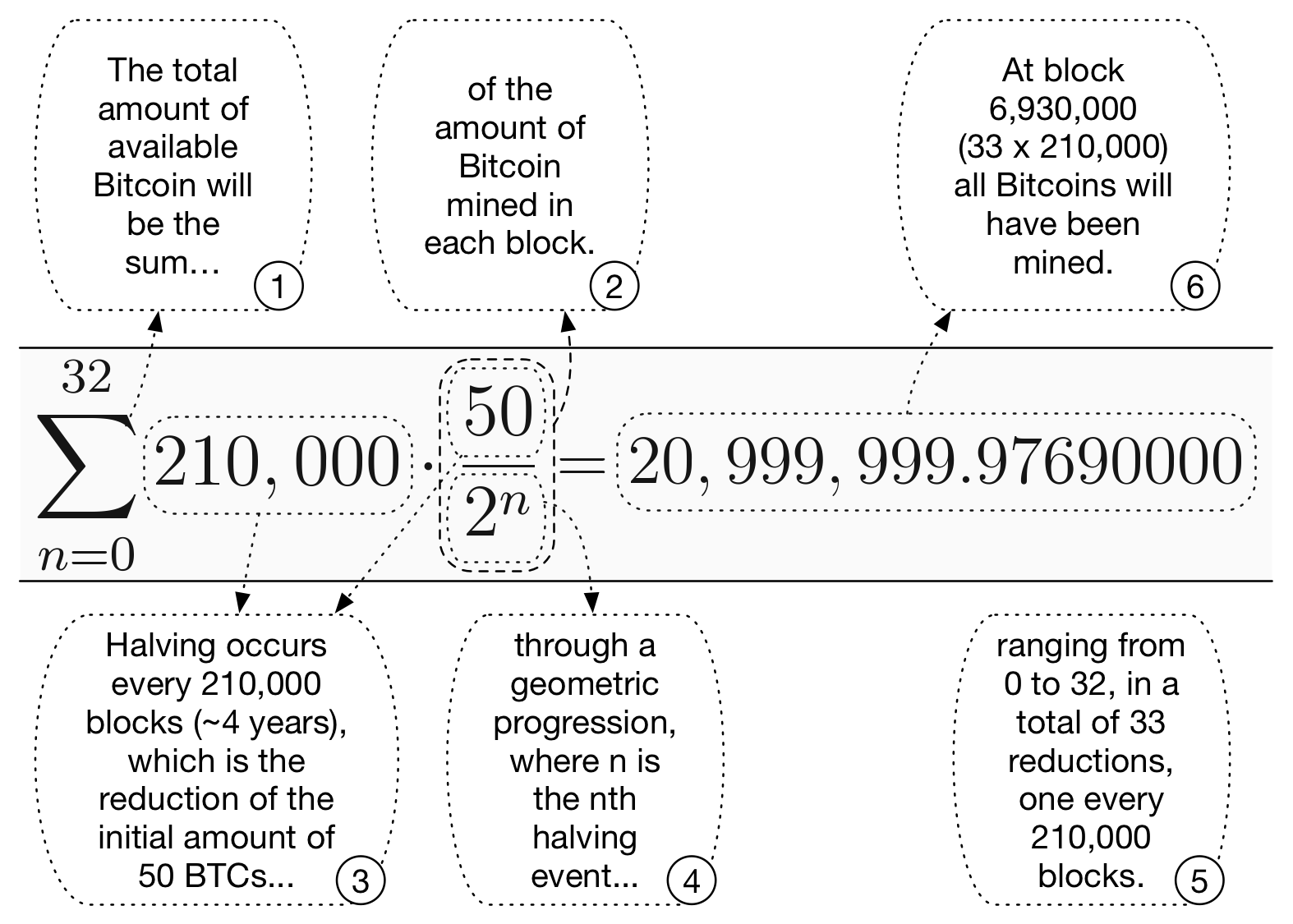
Bitcoin exhibits the properties historically associated with durable forms of money: scarcity, divisibility, portability, verifiability, durability, and recognizability. Its supply is fixed by the protocol and cannot be increased by any central bank or government. Unlike many earlier monies—whether commodity objects, metal coins, or government-issued notes—bitcoin’s rules are enforced by open software rather than by an issuer. For those who study monetary history, this combination of fixed supply and decentralized verification is the primary distinction. The Bitcoin Network provides a transparent ledger and a native asset whose monetary policy is known in advance and does not depend on discretionary authority.
Direct control over bitcoin requires corresponding responsibility. Users must evaluate wallets and exchanges carefully, test small amounts, and learn the distinction between self-custody and third-party services. Time preference also matters: some participants treat bitcoin primarily as a long-term store of value, while others use it for payments or transfers. There is no universal approach. The practical questions are how one intends to use the system, what tools will be used, and how keys will be protected. Self-custody means the user, not an intermediary, is responsible for securing the asset.
Leverage the Bitcoin Network
Explore Bitcoin Network Benefits
The network is for everyone to learn about, practice with, and benefit from no matter where you are in the world and regardless of your circumstances.

Individuals
Personal savings, payments, and self-custody.

Families
Long-term household planning and inheritance.

Businesses
Payments, treasury, and cross-border settlement.

Corporations
Balance-sheet allocation and operational use.

Non-Profits
Transparent donations and global distribution.

Institutions
Custody, research, and portfolio exposure.

Governments
Sovereign reserves and public-sector experiments.

Universities
Research, education, and student projects.

Developers
Open-source software and protocol work.
Up Next: Bitcoin Blockchain
Bitcoin Blockchain →Go back to Education Portal:
← Learn About Bitcoin℠Share the link with colleagues, family, and friends.
Fresh start? Official Bitcoin Network homepage.
By accessing this website you agree to the User Agreement, Privacy Policy, and Legal Notice.